

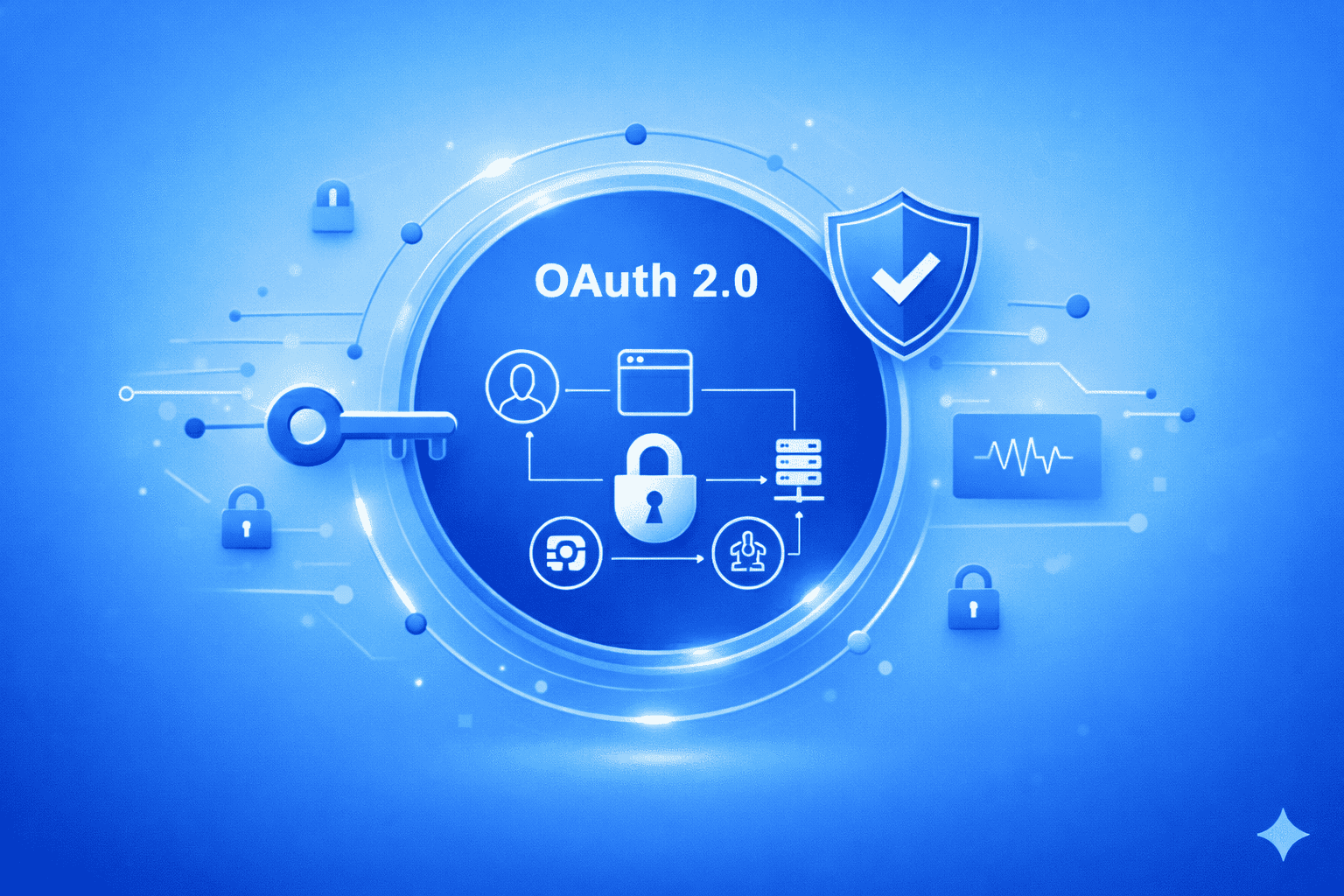

We like to say security is complicated because it makes us feel like we’re doing something impressive. But the truth is, the best security ideas are usually the simplest ones in disguise. OAuth 2.0 is one of those ideas. It became the backbone of modern digital trust not because it was flashy, but because it captured a basic truth: people and applications need a way to share access without sharing secrets. For many teams still asking what is OAuth, the answer starts right here.
Today, OAuth 2.0 authentication sits quietly under everything we touch; mobile apps, enterprise dashboards, IoT devices, multi-cloud integrations, and an entire world moving toward passwordless authentication and passkey-driven authentication. And if we don’t understand what is OAuth, we end up building systems that break in unpredictable and expensive ways. So, let’s walk through OAuth 2.0 and the modern OAuth 2.0 flow.
How OAuth 2.0 Became the Backbone of Modern Access Control?
Imagine a coffee shop. You want someone else, say a colleague, to pick up your latte, but you don’t want to hand over your wallet. So, you scribble a note: “Allow John to pick up my large latte today.” It’s scoped, temporary, and revocable. That note reflects the core idea behind OAuth authentication, and for anyone wondering what is OAuth, that’s the simplest analogy.
Before OAuth 2.0 existed, apps relied on passwords for everything. If App A needed access to App B on a user’s behalf, you handed App A your App B password. It was absurd. As the digital world grew, password-sharing stopped being merely clumsy and became genuinely dangerous. OAuth 2.0 authentication stepped in as the delegation framework we desperately needed, powering every OAuth flow and modern OAuth2 flow we rely on today.
Today, OAuth2 flows are woven into multi-device authentication workflows, mobile-first ecosystems, IoT integrations, and every API economy imaginable. It’s not glamorous. But it’s essential and a core part of OAuth security best practices.
What OAuth 2.0 Really Solves Behind the Scenes?
Let’s break down the cast in plain English:
- Resource Owner: The person who owns the data.
- Client: The app requesting access (a mobile app, backend service, or web app).
- Authorization Server: The system that verifies identity and issues access tokens.
- Resource Server: The API holding the data, verifying tokens, and enforcing scopes.
The magic of OAuth 2.0 is that the client never touches the user’s credentials. It only gets an auth token; a signed, time-bound authentication token. That separation makes OAuth token usage safer, more flexible, and more future proof than old-school token-based authentication schemes or legacy token authentication.
This also strengthens token security, especially when access token and refresh token lifecycles are handled correctly.
How OAuth 2.0 Actually Works in Real Applications?
OAuth isn’t one dance; it’s several. Each OAuth 2.0 flow exists to support a different environment, and choosing the right OAuth flow or OAuth2 flow is critical.
Authorization Code with PKCE
This is the modern default. It’s the most widely trusted authorization code flow for web, mobile, and desktop apps.
- The user authenticates through the authorization server
- The app receives a short-lived authorization code
- The app exchanges that code for an access token
- PKCE adds an extra cryptographic proof step
Because PKCE security hardens the exchange, modern teams pair this authorization code flow with short-lived OAuth token usage and secure refresh token rotation. Every modern authorization code flow is built on these principles, and it’s now a central part of OAuth 2.0 authentication.
Client Credentials (machine-to-machine)
This flow powers microservices, automation scripts, backend-to-backend calls, DevOps workflows, anything without a user behind it.
Today’s best practice enhances this flow using JWT assertions, where the calling system signs a small JWT using its private key. The JWT includes:
- iss – who is making the request
- sub – what identity the server should use
- aud – the authorization server endpoint
- exp – expiry
- jti – unique ID to prevent replay
The authorization server validates the signature using the client’s public key (via JWKS), then issues an access token.
This solves two critical problems:
- No shared secrets floating around
- Private key never leaves the machine that owns it
This is the model mature engineering teams trust.
Refresh Tokens (long-session stability)
Access tokens should be short-lived.
But users shouldn’t have to sign in every 10 minutes.
Refresh tokens bridge that gap, but they’re powerful, so they must be treated like gold:
- stored securely
- rotated regularly
- invalidated immediately on logout
- scoped minimally
Legacy flows we avoid today
A quick hall of shame:
- Implicit Flow (exposes tokens in URLs)
- ROPC (asks users for passwords directly; no, thank you)
Modern security teams have retired these completely.
Choosing and Designing Token Strategies That Don’t Backfire
OAuth doesn’t stop at “which flow.” We also decide what kind of tokens to issue and how to validate them.
JWT Access Tokens
Pros:
- Fast, no introspection endpoint needed
- Self-contained claims
- Works well with distributed systems
Cons:
- Harder to revoke instantly
- Risky if overstuffed with data
- Key rotation must be handled carefully
Opaque Tokens
Pros:
- Token contains no meaning
- Server introspects each use
- Easy revocation
Cons:
- One extra network hop per call
There’s no universally “right” answer. But there is a universally wrong one: issuing tokens without thinking about their lifecycle, permissions, expiry, and verification model.
A well-designed ecosystem will have:
- tokens scoped by permission
- short lifetimes
- purpose-specific audiences
- aud + iss validation
- rotation and revocation built in
- JWKS endpoints for public key distribution
Modern applications increasingly pair OAuth with passkeys or FIDO2/WebAuthn authentication to harden the initial identity proofing, then use OAuth tokens for ongoing authorization. This is security evolving without adding friction.
Security Design Principles We Never Compromise in OAuth Implementations
Here’s where engineering discipline separates strong systems from breach reports.
Our non-negotiables:
- HTTPS absolutely everywhere
Bearer tokens must never travel in plaintext. - PKCE for all public clients
Mobile apps and SPAs cannot safely store secrets—PKCE protects them. - Short-lived access tokens
Minimizes risk if a token leaks. - Refresh tokens treated like a privileged credential
Rotate often, store carefully, and kill immediately when needed. - Strict scope design
Least privilege isn’t optional; it’s architecture. - Audience validation
A token isn’t valid unless it was meant for your API. - JWKS for key rotation
Automatic key discovery prevents outages and keeps signatures fresh. - Tight redirect URI enforcement
Wildcards are the biggest unforced error we see across engineering teams.
The Most Common OAuth 2.0 Mistakes That Destroy Security
OAuth is powerful, but flexible. And flexibility means people mess it up. Here are the repeat offenders:
Using OAuth for authentication instead of authorization
OAuth isn’t identity. If you treat it like identity, you’ll break something. Use OIDC when you need user identity guarantees.
Skipping audience and scope checks
Just because a token is valid doesn’t mean it’s valid for you. This is how cross-service data leaks happen.
Embedding client secrets in front-end apps
If your mobile app contains a secret, congratulations: you’ve made the world’s easiest malware target.
Letting refresh tokens live forever
If your refresh tokens don’t expire, your breach window is permanent.
Copy-pasting outdated tutorials
OAuth has evolved. Implicit and ROPC are dead for a reason.
No key rotation plan
Signing keys shouldn’t live forever. That’s how old keys leak onto GitHub and haunt teams for years.
These are preventable errors. They just require someone to care.
How Mature Teams Implement OAuth 2.0 Today?
If you look at teams that have OAuth sorted out, from mid-sized SaaS companies to global enterprises, you’ll see a consistent pattern:
- A proper Authorization Server with token issuance, expiry control, approvals, and logs
- Private-key JWT authentication for machine-to-machine access
- JWKS endpoints for seamless public key rotation
- Scopes carefully designed around operations, not endpoints
- Environment segmentation (dev/test/prod have isolated credentials)
- Passkey or WebAuthn-based authentication into the authorization server
- Full auditability for token issuance and revocation
- Comprehensive monitoring around token misuse
This is OAuth scaled beyond “getting it to work.” It’s OAuth run like infrastructure.
Why OAuth 2.1 Is the Direction the Industry Is Moving Toward?
OAuth 2.1 trims away the risky parts, standardizes PKCE, and strengthens defaults across every OAuth2 flow and future OAuth 2.0 authentication model. Teams beginning new systems today should adopt these patterns immediately instead of relying on outdated OAuth flow designs or circling back to the question of what OAuth is later, when the cost of change is higher.
A Practical Pre-Launch OAuth Checklist for Real Teams
Before you ship anything OAuth-powered, run through this list:
- Redirect URIs locked and exact
- No secrets stored on front-end clients
- PKCE implemented
- Access tokens short-lived
- Refresh tokens securely stored and rotated
- JWT claims validated (iss, aud, exp, iat)
- Scopes minimized and documented
- Signing keys rotated on a schedule
- JWKS integration tested
- API validates audience + scope for every request
- Machine-to-machine flows use private-key JWTs
- Session revocation flows tested end-to-end
Final Thoughts on Building Human-Friendly OAuth Experiences
OAuth 2.0 isn’t designed to impress architects; it’s designed to protect people. When implemented correctly, OAuth2.0 becomes invisible. Sign-in feels simple, consent screens feel clear, OAuth token renewal happens without disruption, authentication token management feels frictionless, and risk becomes negligible. In a world where complexity keeps accelerating, OAuth 2.0 remains the mechanism that lets systems share access without sharing secrets. For anyone still wondering what OAuth is, the answer is straightforward: it’s how modern digital systems stay secure, scalable, and human-friendly.