

If the last decade taught us anything, it’s that Passwords have aged into one of the weakest links in modern security. We’ve strengthened them, stretched them, wrapped them in complexity, yet attackers still walk through them with alarming ease. In fact, around 81% of hacking-related breaches stem from weak or reused credentials. Even more striking: organizations are discovering breaches at a faster clip; just 241 days on average to identify and contain an incident in 2025. With identity now acting as the new perimeter, the way we verify who is accessing our systems doesn’t just matter; it’s critical.
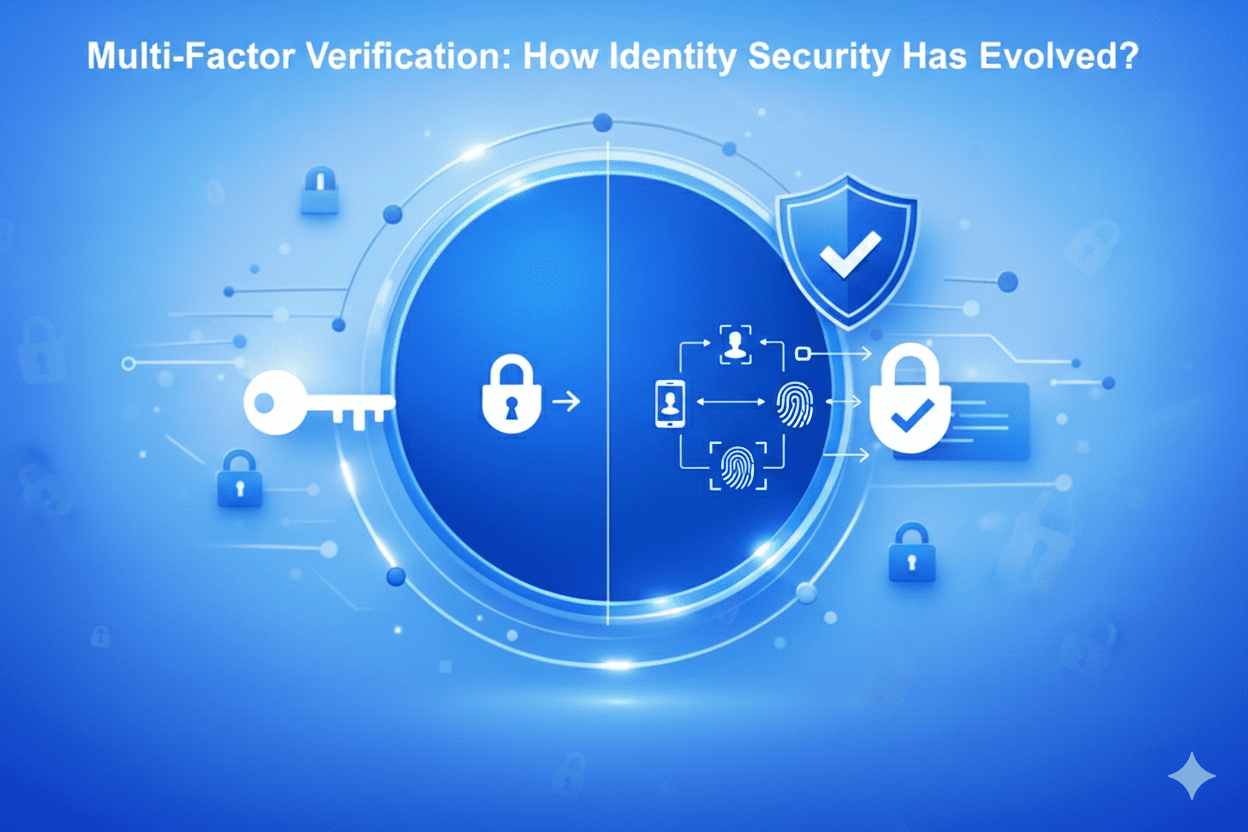
This is exactly where Multi-Factor Verification (MFV) steps in, not as a buzzword, but as the next natural evolution of identity security. To truly understand how we got here, we need to trace the path from Single-Factor authentication to MFA and now, MFV; a shift shaped by attackers who have grown smarter and users who expect frictionless experiences.
From Passwords to MFA: The Early Days of Identity Security
In the early digital era, authentication was a single-factor affair: one password, one user, one hope that nobody else figured out the dog’s name you used for your credentials. Simpler times, sure, but deeply flawed. As attacks grew more sophisticated, password reuse, breach dumps, and predictable patterns opened the floodgates for everything from credential stuffing to automated bot attacks.
This paved the way for Multi-Factor Authentication (MFA); a much-needed upgrade combining something we know (a password), something we have (a device or token), and something we are (biometrics).
MFA raised the bar significantly. Suddenly, attackers needed more than just a stolen password to break in. But as we leaned deeper into MFA, something became very clear: it wasn’t bulletproof. Attackers adapted, users grew tired of endless prompts, and security teams found themselves running in circles trying to plug new gaps MFA didn’t fully address.
Why Traditional MFA isn’t Enough Anymore?
Cyberattacks have grown disturbingly creative. MFA wasn’t designed for a world where:
- Attackers can intercept one-time passwords.
- Push fatigue leads users to blindly approve notifications.
- SIM-swaps break SMS-based authentication.
- Helpdesk teams can be socially engineered in minutes.
- Session hijacking bypasses the need for a login altogether.
We also entered an era where identity became the control plane for the entire enterprise. With cloud as the norm and remote work blurring physical and digital boundaries, verifying identity only at login simply wasn’t good enough. The user behind the session still needed to be continuously validated.
That’s where the MFA story hits its ceiling and where Multi-Factor Verification begins to rewrite the rules.
Multi-Factor Verification: A Smarter, Continuous Approach
Multi-Factor Verification (MFV) expands the concept of identity security beyond the moment of login. Instead of confirming someone’s identity once and hoping nothing changes, MFV continuously verifies identity, context, intent, device posture, and behavioural cues throughout the user’s journey. Where MFA says, “Prove who you are, then you’re in,” MFV says, “Keep proving it as long as you’re here.”
MFV doesn’t rely on a static combination of factors; it layers in risk signals that evolve in real time. These include:
- Device trust and posture
- Behavioural biometrics
- Geolocation anomalies
- App-level permission signals
- Network trust
- Session context
- Historical user patterns
In other words, MFV brings a more holistic, dynamic view of identity. Instead of verifying your login, it verifies you.
MFA vs MFV
| Feature | MFA | MFV |
|---|---|---|
| Primary purpose | Validate identity at login | Continuously validate user and session |
| Factors used | Knowledge, possession, biometrics | Behaviour, device trust, context, risk signals |
| Protection level | Strong, but static | Strong, adaptive, ongoing |
| User experience | Interruptive, prompt-heavy | Seamless, passive, contextual |
| Resilience to modern attacks | Moderate | High |
MFV isn’t about adding more friction. Quite the opposite, it’s about reducing noise and verifying identity silently in the background. And in today’s environment, that’s exactly what enterprises need.
Where MFV Makes the Biggest Difference?
Some scenarios practically demand MFV, because the risks involved are simply too high for traditional MFA to handle alone.
1. Privileged Access
Admins, developers, and power users are high-value targets. A single mis-verified session can expose entire systems. MFV ensures every elevated action is continuously validated.
2. Device Switching and Remote Work
Users change networks, devices, and locations constantly. MFA doesn’t re-check identity. MFV does and it does so silently.
3. Social Engineering Defense
Attackers know how to charm helpdesks and manipulate stressed employees. MFV reduces dependence on human judgement by letting risk signals validate identity objectively.
4. High-volume Workforce Environments
Contact centres, retail stores, and healthcare systems see shared workstations and frequent logins. MFV helps ensure every session belongs to the right person, not the person who last used the device.
5. Application-level Access Verification
It’s not enough to verify the person accessing the system. MFV verifies whether they’re authorized to access specific apps or perform certain actions, closing a massive gap MFA never addressed.
How Organizations Implement MFV without Creating Chaos?
Shifting from MFA to MFV sounds daunting, but it doesn’t have to be. Organizations that succeed tend to follow some practical principles:
- Start with device trust: A verified device is a foundation for verified identity. If you trust the device, you reduce risk signals before they even surface.
- Adopt behavioural biometrics gradually: Typing cadence, mouse patterns, touch pressure; these can run passively without annoying users.
- Use adaptive, risk-based workflows: Users should see prompts only when something feels off, not because a rigid rule says so.
- Integrate MFV into existing identity platforms: Identity orchestration, IAM systems, and SSO platforms often support MFV-ready signals already.
- Prioritize user experience: If security adds friction, users find a workaround. If security feels invisible, adoption becomes natural.
Challenges and Realities to Navigate
Even though MFV offers a massive leap in protection, organizations must still navigate a few realities:
- Balancing privacy and security: Behavioural analytics can feel intrusive if not communicated transparently. Strong governance is essential.
- Ensuring data minimization: More signals don’t mean more storage. MFV should analyze data in real time, not hoard it.
- Avoiding over-reliance on AI: AI helps detect anomalies, but humans still need visibility and control. Automated decisions should always be explainable.
- Preparing for cost and integration effort: MFV needs a solid IAM foundation. Organizations with fragmented identity systems often need to clean up before levelling up.
These challenges aren’t roadblocks; just reminders that evolving identity security is a strategic shift, not a feature upgrade.
The Future of Identity: MFV Is Only the Beginning
As attackers adopt AI, deepfakes, and increasingly convincing social engineering tactics, identity verification must continue evolving. MFV is a major turning point, but the road ahead includes even more powerful trends:
- Passkeys mainstreaming, reducing reliance on passwords entirely
- Decentralized identity models, giving users more control
- Continuous identity assurance, blending behaviour, risk, and context
- Hardware-rooted trust, securing identity at the chipset level
- AI-driven verification loops, predicting anomalies before they escalate
Identity isn’t becoming simpler, but it is becoming smarter. And with MFV in place, enterprises finally have a framework that moves beyond “front-door security” and into end-to-end verification.
Conclusion
We’ve come a long way from the days when a single password guarded entire digital worlds. MFA gave us a much-needed boost, but attackers moved too fast for static controls to keep up. Multi-Factor Verification is the evolution identity security needed; more adaptive, more continuous, and far more aligned with how people work today.
For organizations serious about protecting users, data, and applications, MFV isn’t just a security upgrade. It’s a mindset shift: stop verifying logins and start verifying people. That’s the future of identity, and it’s already here.
FAQs
What is Multi-Factor Verification (MFV)?
Multi-Factor Verification goes beyond traditional MFA by continuously validating user identity, device trust, and behavioural context throughout a session. It ensures ongoing verification instead of relying on a single login event.
How is MFV different from MFA?
MFA verifies identity only at the moment of login, while MFV keeps evaluating risk signals in real time. This continuous approach protects against modern attacks like session hijacking, social engineering, and push fatigue.
Why do organizations need MFV now?
Attackers have evolved past traditional MFA, using techniques like SIM swapping, OTP interception, and helpdesk manipulation. MFV gives enterprises adaptive, risk-based protection aligned with modern cloud and remote-first environments.
Does MFV increase friction for users?
No, MFV reduces friction by verifying identity passively in the background. Users only see prompts when real risk is detected, creating a smoother and more secure experience.