

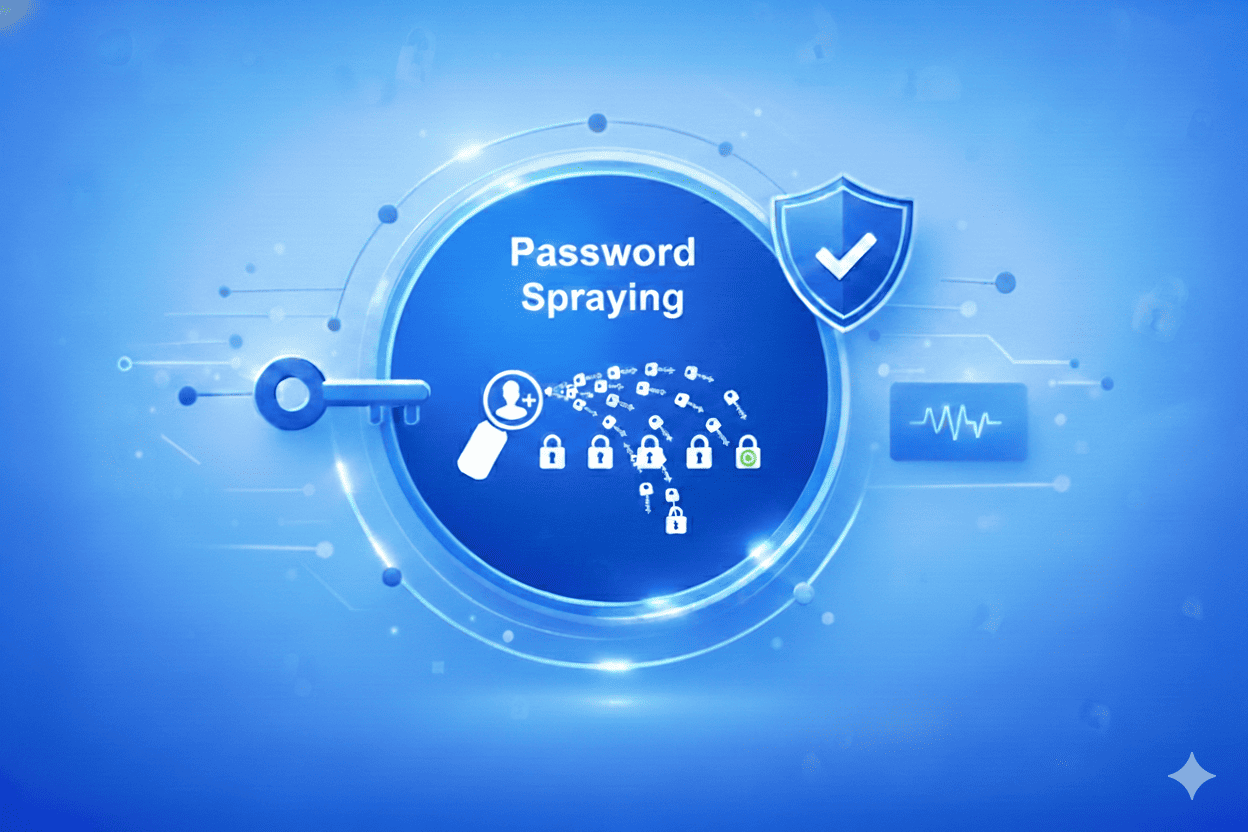

Password spraying is one of the most insidious types of brute-force password attacks in cybersecurity today. Unlike traditional brute-force methods which bombard a single account with thousands of passwords, a password-spray attack reverses the tactic. Attackers try a handful of common passwords across hundreds or thousands of user accounts.
This spraying attack is designed to exploit weak or reused passwords while flying under the radar of traditional security defenses. Because attackers only attempt a few failed logins per account, they easily bypass rate-limiting and lockout controls, making password-spraying attacks a stealthy and highly effective intrusion method.
In this blog, let us understand what is password spraying attack, how password spraying attack works, few examples, and some tips to prevent the same.
Password Spraying Meaning & Why It’s a “Brute Force” Variant?
Despite being slower and more deliberate, password spraying still falls under the brute-force attack definition. The password spray attack meaning centers on a systematic trial-and-error process testing one password against many accounts to identify valid credentials.
In essence, it’s still a password attack driven by brute computational force but distributed intelligently. By spacing out attempts, hackers prevent detection and avoid triggering account lockouts, making this password-spraying attack a refined evolution of traditional brute force hacking.
Red Flags: Signs Your Organization is Under Password Spraying Attack
Password-spraying attacks operate “low and slow,” they rarely trigger loud security alerts. Instead, they leave subtle traces that security teams must learn to spot. Here are a few signs you have to look at:
1. Unexpected Account Lockouts
A user suddenly getting locked out despite entering the correct password may signal a password-spraying attack. Multiple failed attempts from different IPs can trigger lockouts by spreading login errors across many accounts.
2. Unusual Login Activity
System logs showing logins from new devices, unrecognized regions, or odd hours are tell-tale signs of an active spraying attack attempting to validate stolen credentials.
3. Multiple Distributed Failed Logins
If the same password is tried across multiple usernames within a short time, it’s likely a password spray attack. Attackers deliberately spread failed attempts to avoid account lockout triggers.
4. Unexpected MFA Prompts
Repeated MFA requests users didn’t initiate could signal a password-spraying attack where the password is already known, and the attacker is attempting to bypass MFA defenses.
5. New Device or Location Access
Logins from unfamiliar devices or unfamiliar foreign geolocations often could mean a password-spraying campaign successfully validated stolen credentials.
6. System or Network Slowdowns
Small spikes in authentication traffic or sluggish system performance can result from botnets conducting large-scale password spraying attacks in the background.
How Password Spraying Attacks Work: A Methodical, Stealthy Invasion?
Understanding what a password spraying attack looks like helps strengthen your defensive posture. The attack follows four precise steps:
Step 1: Choosing the Right Passwords
Attackers begin by collecting the weakest, most predictable passwords – “123456,” “Password!,” “Welcome2024.” These come from leaked credentials or public breach datasets, confirming real-world usage. The prime vulnerability is for the users who reuse or fail to change passwords, giving attackers an instant advantage.
Step 2: Targeting Many Accounts
Rather than focusing on one victim, hackers spray the same weak password across thousands of usernames. The broader the target pool, the higher the success rate. Large enterprises are especially exposed because of scale and user diversity.
Step 3: Evading Lockout Policies
This is the brilliance of the password-spray attack. By spacing login attempts over time say, one per hour per account hackers bypass traditional account-lockout mechanisms. Each failed login blends in with legitimate user error, making the attack nearly invisible.
Step 4: The Takeover
Once a password matches, attackers don’t stop. They move laterally, escalate privileges, and expand their foothold. A successful password-spraying attack often becomes the entry point for ransomware or large-scale data exfiltration.
Effects of Password Spraying Attacks
Password spraying doesn’t just expose individual accounts; it creates a ripple effect across your entire organization. Once attackers break in, even through a single weak password, they can pivot, escalate privileges, and launch broader attacks that impact security, finances, and trust. Let us understand the different ways password spraying attacks can impact an organization:
1. Immediate Financial and Operational Damage
The attack’s financial fallout is immediate and varied. While attackers certainly use validated credentials to steal financial data and make fraudulent purchases, they also target valuable, non-monetary assets. This includes stealing sensitive data about proprietary software to sell to competitors or exploit later.
Crucially, these attacks don’t just happen in the background they actively slow down daily operations. Your business must dedicate significant, unexpected resources to stopping the attack and completely expelling the attacker from the network, diverting staff and capital away from strategic business goals.
2. The Crippling Effect on Trust
Perhaps the most lasting damage is to your reputation. If your business fails to properly and completely disclose the attack to customers and stakeholders, public trust will erode rapidly. This lack of confidence directly influences public perception of your organization’s security posture and can negatively affect stock prices and customer loyalty.
3. The Gateway to Catastrophe
Ultimately, a password-spraying attack is rarely the final act; it is the gateway into your proprietary network. The validated credentials give the attacker a persistent foothold, making your organization vulnerable to a chain reaction of more damaging cyberattacks. For example, the information gleaned from the spray can be used to launch a highly successful phishing campaign, where they pose as a trusted employee to ensnare further victims within your organization.
How to Detect Password Spraying Attacks?
Detecting credential-spraying attacks starts with recognizing patterns specifically, a sudden spike in failed logins hitting many accounts at once. When you know what to look for, these attacks become much easier to catch early.
1. Centralized Logging and Analysis
The first step to strong detection is bringing all authentication logs together in one place. Whether your systems use LDAP, VPNs, web apps, or identity providers, funnel those logs into a SIEM like Splunk or Elastic.
What to look for:
A cluster of failed login attempts across many different users coming from the same IP (or a small set of IPs) within a short timeframe often within 5 to 30 minutes. This pattern is a classic sign of credential spraying.
2.Watch Authentication Protocols Closely
Different authentication protocols leave behind different clues. Older protocols like LDAP make these clues even clearer.
LDAP (Port 389/636): Failed bind attempts with “invalid credentials” errors happening repeatedly across multiple accounts are a major red flag.
Modern Web Auth (SAML/OAuth/OIDC): Look for the same suspicious patterns mass failures from the same IP inside your cloud identity logs.
3. Track Geographical and Behavioral Anomalies
Attackers often hide behind internal IPs, VPNs, or global proxies, which is why behavior-based detection is critical.
Geography: Logins suddenly coming from a foreign country, a Tor exit node, or a known risky VPN provider should immediately trigger alerts.
Timing: Spraying attacks often happen outside normal hours late nights, early mornings, or weekends when fewer people are watching.
4. Rate Limiting
While these tactics help stop attacks, they also make them easier to detect.
IP-based rate limits: Restrict how many login attempts an IP can make per minute. Attackers are forced to slow down, revealing their activities.
Adaptive throttling: Automatically increase delays after repeated failures from the same IP to both discourage attackers and surface suspicious behavior more clearly.
5. Use User Behavior Analytics (UBA)
UBA tools help build a “normal behavior profile” for each user making anomalies stand out immediately.
Velocity checks: If an account suddenly succeeds in logging in right after a storm of failed attempts from the same source, that’s a strong signal that attackers finally stumbled on the right password.
First-time login alerts: Flag accounts that log in from a completely new geography or an unrecognized device especially after recent failed attempts
Prevention Tips: How to Prevent Password Attacks?
Preventing a password spraying attack demands both human and technical defenses working together. Here are a few prevention tips that you can implement:
- Encourage Strong Password Policies
Mandate long, complex passphrases and block common passwords. Require users to change default credentials immediately.
- Implement Strategic Login Detection
Monitor patterns across the entire domain, not just individual accounts. Track simultaneous username targeting a key sign of password-spraying behavior.
- Fine-Tune Lockout Policies
Adjust thresholds to stop brute force without inconveniencing users. Combine with self-service password reset options for easy recovery.
- Require Multi-Factor Authentication (MFA)
MFA is the strongest defense against password spraying and credential stuffing. Even if a password is guessed, the attacker can’t pass the second verification layer.
- Deploy CAPTCHA and Unique Usernames
Implement CAPTCHA at login endpoints to filter out bots. Use non-standard username formats to reduce the attack surface.
- Move Toward Passwordless Authentication
Eliminate the root cause of password attacks altogether. Passwordless authentication replaces static credentials with Biometrics, Passkeys or device-bound tokens, rendering password-spray attacks obsolete.
Examples of Password Spraying Attacks
| Year |
Victim / Target |
Description |
|---|---|---|
| 2020 |
Microsoft / enterprise accounts |
A botnet of ~130,000 devices launched a large-scale password spraying campaign targeting Microsoft 365 service accounts, distributing login attempts across many IPs and bypassing MFA via legacy protocols. |
| 2020 | U.S. & U.K. healthcare + pharmaceutical research organizations |
Attackers used credential-cracking / password-spraying against healthcare entities during the COVID-19 era, recognizing weak authentication and global supply-chain exposure. |
| 2019 | Citrix | In 2019, Citrix was breached and the incident involved weak authentication policies exploited via password spraying or related methods, with ~6 TB of sensitive data stolen. |
| 2024-25 |
Microsoft 365 + large enterprises |
There are reports of major APT groups using password spraying to compromise enterprise accounts — for example, a Russia-backed group (“Midnight Blizzard”) targeting Microsoft networks via password spraying. |
Conclusion
Password spraying remains one of the most effective and overlooked attack methods in modern cybersecurity. It exploits weak or reused passwords to gain unauthorized access without ever triggering the account lockouts designed to stop brute force. While immediate defense requires sophisticated detection using behavioral analytics and proactive monitoring across all login endpoints true and lasting security demands a fundamental shift.
The time has come to eliminate password dependency altogether. By mandating robust Multi-Factor Authentication (MFA), Adaptive access controls, and a comprehensive Passwordless strategy, organizations don’t just stop password spraying; they significantly reduce their entire attack surface. Modernizing your identity strategy is the only way to move past the legacy risks and secure a truly resilient, frictionless access future.
FAQs
How do you detect password spraying?
Password spraying is detected by monitoring authentication logs for unusual login patterns, such as multiple failed attempts across many accounts, identical password use, and logins from unfamiliar IPs or geolocations. Behavioral analytics and velocity checks enhance detection accuracy.
What are the most common passwords for password spraying?
Attackers often test weak, predictable passwords like Password123, Welcome2024, Qwerty!, and Summer2023. These common credentials are frequently reused across systems, making them prime targets for password spraying attacks.
What are the risks of password spraying?
The main risks include unauthorized account access, data theft, and service disruption. For enterprises, password spraying can lead to large-scale account takeovers, compliance violations, and financial or reputational damage.
How is password spraying different from credential stuffing?
In password spraying, attackers try a few common passwords across many accounts. In credential stuffing, they use real, stolen username–password pairs from data breaches. Both exploit weak password practices but differ in data sources and execution.
How do password leaks happen?
Password leaks typically occur through data breaches, phishing attacks, insecure storage, or insider threats. Once leaked, these credentials are sold or shared on the dark web, fuelling password spraying and credential stuffing attacks.
How do attackers automate password spraying attempts?
Attackers use automated tools and botnets that test passwords across multiple accounts while rotating IPs and user agents. These tools mimic legitimate login behavior, helping them evade traditional rate limits and detection systems.
How can organizations detect password spraying activity in real time?
Organizations can use SIEM systems, bot management, and adaptive authentication tools to monitor failed logins, IP velocity, and behavior anomalies. Real-time alerts for unusual login spikes enable faster response to password spraying attempts.
What authentication logs or metrics should be monitored to identify password spraying?
Track failed login rates, repeated passwords across different accounts, login times, IP geolocation mismatches, and device fingerprints. Correlating these metrics helps uncover password spraying activity before it escalates into account compromise.